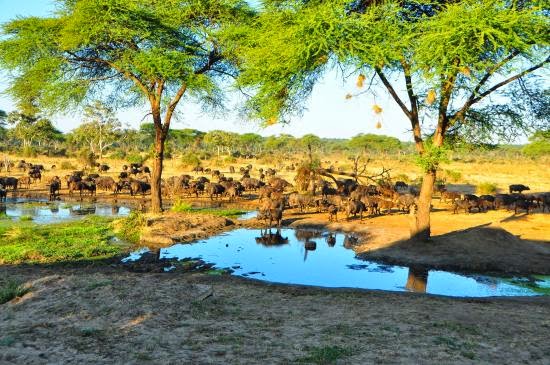
Showing posts with label Botswana Animals. Show all posts

Friday, September 29, 2017

Makgadikgadi Pans National Park - Botswana

Meno A Kwena Tented Camp


Camp Kalahari 


Jack's Camp 


Wednesday, March 22, 2017

Botswana's Famous Jack's Camp

A relic of one of the world's largest super-lakes, the Makgadikgadi dried up thousands of years ago as a result of the continued shifting of the earth's crust.

Jack's Camp is sited in this prehistoric setting offering just ten bedouin-style canvas tents with en-suite bathrooms and spacious bedrooms with persian rugs and cool cotton sheets.


Tuesday, November 22, 2016

Cheetah's in Botswana


Cheetah's are found throughout the wilderness areas of Botswana - even in the arid reaches of the Kalahari.

Best places to see them:
Chitabe in the Okavango Delta, Linyanti (in particular Kwando).

Cheetah have one of the highest success rates when it comes to hunting but of all the predators they are the most likely to have the kill stolen away. They have to eat very quickly once they have killed as other predators are quickly on the scene. Vultures have been known to steal kills from Cheetah.

Personal observations of Cheetah hunts reveal varying methodsof operation. A family group of a mother and her five offspring in the Savute Marsh would often use a flanking manoeuvre during a hunt.

Two individuals would flank a herd of Antelope before revealing themselves in a half hearted chase. The prey would scatter in all directions with at least one heading in the direction where the other three were waiting in ambush.

Although Cheetah rely on speed during a chase a great deal of patience and stalking goes into a hunt. During a chase prey is knocked to the ground in mid stride after which the cheetah suffocates the prey by clamping its jaws on the victim's air pipe.
Cheetah are susceptible to competition from other predators and are the first to move away from an area when competition gets too much. The previously mentioned group of Cheetah in the Savute eventually moved out of the area when Hyenas continually stole their kills.

The Hyenas developed the habit of following the group on a hunt and when a kill was made would move in immediately and steal the food.

Wednesday, May 11, 2016

The first rule in tracking lions: NO running!!

Walking safaris in Botswana bring travellers out of the jeep – and their comfort zone – and onto the dry, African soil to hunt for one of the greatest predators in the animal kingdom.

 Taking a simple walk had never seemed so dangerous. Gathered around a camp table set up with maps, field guides – and gin and tonics – we plotted our stroll into the late afternoon heat. Normally jovial, our guide Paul Ditiro looked around the group, fixing us with a serious look. “The first rule is no running – at all,” he said, his usual glimmer of mirth buried in the gravity of the moment. “And we will walk in a single file line, with me at the head. We have four of the big five out there – and you can easily stumble into them. This is the best way to truly encounter nature. You can smell and touch and taste and feel it. It’s a truly unique thrill.”

I was at Footsteps Across the Delta, a small, remote camp deep in the heart of Botswana’s famed Okavango Delta. As its name suggests, Footsteps focuses exclusively on “walking safaris”, small hikes that bring people out from the jeep – and their comfort zone – and onto the dry, African soil. Here, I would take two daily hikes, always accompanied by an armed guide. The Okavango surrounds travellers with a plethora of bird and animal life, but I was here seeking just one thing: big cats.
 

Our group was an unlikely band of adventurers – a middle-aged doctor-lawyer couple from Scotland, an elderly but able Spanish couple from Barcelona, and me: a tenacious – but slightly terrified – travel writer. As we ambled out of camp, headed for a small pond known as Paul’s Pan (so-named by our leader, after himself), poufs of dust billowed out from under our boots. The Okavango is part of the Kalahari Desert, and nothing but a thin layer of scorched grass and 300m of sand lay under our feet. Botswana is a perennially thirsty country, a place that’s 70% desert, where a drop doesn’t reach the ground for 10 months of the year. Perhaps to appease the gods of precipitation, the country has named both its currency and its national road system pula – in English, rain.


But being here just a few weeks before the start of the annual December rains gave us a strategic advantage in our search for felines. During the dry season, animals don’t have the luxury of shady, green hiding places. They’re flushed out onto the barren, brown savannah, and forced to gather at the few sources of water not yet sapped by the relentless and unforgiving sun.

Indeed, not 10 minutes into our first walk, we came across some wildlife – two giraffes, which we caught in the middle of a rather private moment. The jokes flowed naturally. “Ah, look at those two necking,” one of the Scots said. “She only wanted a back rub,” chipped in one of the Spaniards. Ditiro used this as a teachable moment. As the giraffes decided to make trails away from us – looking none too happy – Ditiro explained the humans have binocular vision, something that we share with all other predators. When prey animals (zebras, antelopes, giraffes) see eyes on the front of the head, they instinctually know that the animal (lion, leopard, or human) is a threat.

Ditiro then switched gears, kneeling down over a big, dry pile of scat. “You see, even elephant dung is fascinating,” he said, picking through it with a stick. He proceeded to open it up, showing us what the animal had eaten, and explaining how, in years past – and sometimes, even now – the stuff was used in the day-to-day lives of locals. “This dung can have medicinal qualities, and when you burn it, it keeps away mosquitoes,” he explained.

We proceed farther out from camp, skirting both Paul’s Pan and another small pond, the latter inhabited by a single, ornery hippo who snorted his displeasure as we passed. “He is showing us how tough he us,” Ditiro explained with a smile. As we walked, Ditiro shared stories from more than a decade of guiding at Footsteps – from the time their resident hyena, nicknamed Fat Albert, snuck in and sunk his teeth into a fire extinguisher, causing it to explode (he was fine, and back in camp scavenging again a few nights later) – to the night a leopard brought her kill into camp and ate it in a tree, right over top the campfire (fortunately, everyone was safely ensconced in their tents).


But the friendly banter stopped when Ditiro spotted something unusual: a couple of vultures in a nearby tree. Motioning to them, he said, “when you get 10 or 15 of those, then you know you have barbecue down below.” But as we walked toward them, more and more vultures gathered, landing on the leafless tree and swooping overhead. “We have a curious situation,” Ditiro said, suddenly serious. “Stay close, and single file everyone – no gaps.”

We passed the vulture tree – all of us keenly aware of the danger that may be all around us – and emerged into a large, open area that would be a meadow after the annual rains.

Disappointingly, there was nothing. No big cats or other predators in sight.

We ventured out on the plains and pans several more times over the next few days, but the encounter with the vultures was the closest we would come to seeing any big-time hunters at Footsteps. While lions and leopards are commonplace in the Okavango, sightings are never guaranteed, and these creatures can be fickle – staying and sleeping in one area for days, then stalking dozens of miles away, at the drop of a hat.

But Ditiro assured me that we would see one – there had been sightings at other camps reported over the radio network that connects these far-flung spots – so he and I left the group to visit another camp, Kanana, to continue our search.

Few of the Okavango’s more than 60 safari camps are connected by road, and access is provided by a handful of small Cessna airlines, which shuttle visitors from camp to camp, bumping down on grass or dirt landing strips and tarrying only long enough to drop one load of guests and pick up another.

We touched down at Kanana, quickly getting down to business. There, our excursions mixed driving and walking, taking a jeep deep into the hinterland, then hoofing it through tall, brittle grass and across vast, scorched savannah. Camp managers told us that lions had been spotted in the area – two males, in their prime. As we drove down the sandy road, Ditiro – one hand on the wheel – leaned a long way out of the open side of the vehicle, spotting and dismissing, one by one, different sets of tracks. “No, just baboon,” he would say, quietly, or “far too old”. But then he saw what we were looking for – lion tracks, fresh ones. “The tracks are the most important thing,” he said. “The tracks lead you to the animal.”

Ditiro parked the jeep and slung a big .458 rifle (sometimes inelegantly known as an “elephant gun”) over his shoulder as we trudged back into the long grass. At first, there was no sign of lions, but Ditiro read the behaviour of the animals around us – or lack thereof. The fact most of the prey had vacated the area was a good sign that the lions were here.

We made a big, crazy circle on foot – from the jeep, through several meadows, around a big pan and back to the jeep – but we still couldn’t find them. On a whim, Ditiro decided that we should turn back – and that’s when we saw them, two big boys hunkered behind a set of bushes. We had walked within a few metres of them earlier, completely unawares.

Ditiro cocked the gun as one of the lions sat up on his haunches, eying us with an intensity that I had never before encountered. I was now prey, and nothing but a bit of African savannah, Dit


iro’s elephant gun and the whim of a cat stood between me and certain death. It was terrifying.

As the lion slowly waved his tail, Ditiro told me to hold steady. “He is deciding whether or not to charge,” he said, as my heart pounded in my ears. “He’s about 50m away. He could close this distance in less than two seconds.” I had never before felt so exposed – just a guy standing on his own two feet staring down one of the greatest predators in the animal kingdom.

“Look at those muscles, look at those claws,” Ditiro told me, in hushed tones. “He’s a pure killing machine.” After a few minutes – maybe five, maybe 15 – it was time to go, and the lion didn’t charge.  Bumping back to camp, I felt the adrenaline coursing through my veins, a natural high that I will never forget. In the rosy glow of that rush, I felt eternally fortunate. Happy to have had such an amazing experience. And lucky to be alive.

Tuesday, April 12, 2016

Welcome to Botswana


Blessed with some of the greatest wildlife spectacles on earth, Botswana is one of the great safari destinations in Africa. There are more elephants in Botswana than any other country, the big cats roam free and there’s everything from endangered African wild dogs to aquatic antelopes, from rhinos making a comeback to abundant birdlife at every turn.


This is also the land of the Okavango Delta and the Kalahari Desert, at once iconic African landscapes and vast stretches of wilderness. Put these landscapes together with the wildlife that inhabits them, and it’s difficult to escape the conclusion that this is wild Africa at its best.


Botswana may rank among Africa’s most exclusive destinations – accommodation prices at most lodges are once-in-a-lifetime propositions – but self-drive expeditions are also possible. And whichever way you visit, Botswana is a truly extraordinary place.


Top responsible travel tips for Botswana

1. Be considerate of Botswana’s customs, traditions, religion and culture.

2. For environmental reasons, try to avoid buying bottled water. Fill a reusable water bottle or canteen with filtered water instead.

3. Always dispose of litter thoughtfully, including cigarette butts.


4. When bargaining at markets, stay calm, be reasonable and keep a smile on your face. It's meant to be fun!

5. Learn some local language and don't be afraid to use it - simple greetings will help break the ice.


6. Shop for locally made products. Supporting local artisans helps keep traditional crafts alive.

7. Refrain from supporting businesses that exploit or abuse endangered animals.

8. Please ask and receive permission before taking photos of people, including children.


9. When on community visits or homestays, refrain from giving gifts or money to locals.

10. Refrain from buying ivory or other products harvested from endangered animals.

Thursday, January 21, 2016

Seven Wonders of Botswana

What are the Wonders of Botswana?  

 Botswana is home to one of Africa's Seven Wonders of Nature, but that is only a start to the wonders this country offers. Botswana is truly an African gem for encounters with nature, but the country is also rich in culture and heritage.


Okovango Delta 

Okovango Delta is the largest inland delta in the world formed from the Okavango River’s tectonic drain. The delta has almost 11 cubic kilometers of water spreading over its area of almost 15,000 square kilometers. Okavango Delta is rich in wildlife and provides an opportunity to see the Big 5. 
 
Kubu Island
 
 Kubu Island is made up of dry granite rocks situated in Botswana’s Makgadikgadi Pan. Kubu Island is a national monument and a consecrated place for the indigenous people. Kubu actually means large rock, but can also mean hippopotamus in Tswana.

 Moremi Game Reserve
Moremi Game Reserve is one of Botswana’s national parks. The park’s name was taken from the BaTawana tribe’s chief, Chief Moremi. It is one of Botswana's wildlife viewing gems.

Tuli Block

This narrow border of Botswana lies in between Zimbabwe and South Africa. Tuli Block is known because of its geographical features such as the Solomon’s Wall and Lepokoe Hills. This piece of land features beautiful rock formations, abundant wildlife, strange vegetation and of course, a rich archaeological heritage.

Tsodilo Hills

The Tsodilo Hills, a UNESCO World Heritage Site, has exceptional spiritual and religious connection to locals. Tsodilo Hills traces human settlement over hundreds of decades. The hills features rock paintings of more than 4,500 within its 10 square kilometer area.


Tuesday, April 14, 2015

The Beautiful Senyati Safari Camp

For the Animal Lovers

http://www.botswana-reservations.com/accommodation.html

Situated in the Lesoma Valley, Northern Botswana, 20km from Kasane.Senyati Safaricamp can accommodate both campers and those who prefer some ‘home’ comfort. Although Senyati Safari Camp is very private, the waterhole knows no privacy. A variety of animals come and go throughout the day. The waterhole is frequented by a good variety of species such as hyena, banded mongoose, warthogs, roan antelope, monkey baboons, buffalo, sable, elephants and the occasional leopard.


 An early morning cup of coffee can be enjoyed on the deck while the vultures enjoy their early morning drink.  Baboons come from every direction, drinking, eating and even “walking on the trees”.  On a regular basis, mid-mornings is the time to see the roan antelope visit; with the occasional early morning visit from a leopard.  One fish eagle, in particular, has made Senyati’s waterhole his home.


 As evening falls and darkness comes the waterhole is lit by yellow flood lights.  While enjoying a sundowner guests are able to enjoy watching family after family of elephants arriving for their evening drink, some even taking a swim.  Once their thirst is satisfied they nobly wonder off into the bush only to repeat their evening ritual the next day.


December and January are the two months favoured by birdwatchers for visiting Senyati Safari Camp.  During these two months there is an abundance of various bird species.  Watchers are able to enjoy their favourite hobby sitting on the deck watching, twitching and ticking off their list of ‘must sees’ as the day progresses.

For more information please contact us at 

Friday, September 20, 2013

The OKAVANGO Delta

From DELTA .....to DESERT....explore BOTSWANA
                              

The Okavango Delta provides abundant life at the heart of a desert...
There is a very wide range of accommodation available in the Okavango Delta. This ranges from five star luxury to more humble accommodation, but all fall within the government’s high value, low volume tourism strategy. 

As an important Safari Destination within not only Botswana but also Africa as a whole, The Okavango Delta hosts a number of safari operators. These operators range from well known international brands to local operators and offer the full range of Holiday Specials. Whether you are interested in a simple camping trip or a full five star safari an operator exists to service your needs.


TOURISM

Tourism to the Okavango Delta ...makes up a majority of the tourism component of Botswana’s GDP. Approximately 100 000 people visit the 60 or so camps and lodges in the Delta contributing greatly to the economy of the region. A developing industry the government is keen to continue to deliver policies that encourage tourism.


Botswana’s Okavango Delta is a facinating and unique wildlife location. 
It is the worlds largest inland delta and situated in an extremely arid region and attracts great concentrations of diverse animals and birds. 

The PERFECT African Destination

1. AIRLINK adds new service to its Botswana Operation


3. World Class Game Viewing
 2. Paradise for Shopaholics                  

 4. Unrivaled choices of a Luxury Safari Experience
   

A TRULY MAGICAL EXPERIENCE

Please contact Namibia Reservations at
info@namibiareservations.com / www.namibiareservations.com

Friday, August 2, 2013

Chobe Marina Lodge - Kasane, Botswana


Uniquely located in the North-Eastern corner of Botswana where the four African nations of Botswana, Zambia, Zimbabwe and Namibia converge, Chobe Marina Lodge is surrounded by the natural beauty of Africa.
The Chobe River, Chobe National Park, Kasane Forest Reserve, the Caprivi Strip and the mighty Zambezi river, each offer their own attractions and with Victoria Falls but 70 kilometres away, Chobe Marina Lodge is a 'must visit' destination when in Southern Africa.

With the world-renowned Chobe National Park just 10-minutes from Chobe Marina , an encounter with Africa's awesome foursome (elephant, leopard, lion and buffalo) is definitely on the cards. A river boat trip to the park, will introduce you to a totally different game viewing experience.

Try your hand at fishing for the famed tiger fish, which inhabit the Chobe and Kasai River systems. Golfers too are catered for with a golf course in close proximity to the lodge.

Thursday, January 20, 2011

Botswana Package offered by Southern Africa Travel

This tour starts from Kasane and offers guest the opportunity to experience a boat trip, visit the National Park and enjoy the scenery and wildlife of Botswana.

2 Persons - Double Room at The Garden Lodge (FI) for 1 Night incl 1 Game Drive & 1 Boat Trip into the Chobe National Park,
Nata Lodge (BB) for 1 Night incl. 1 Game Drive into the Sowa Pan,
1 Double Tent at Audi Camp (BB) for 2 Nights incl. 1 Day Moremi Game Reserve Safari
Drotsky’s Cabins (DBB) for 2 Nights incl. 1 Day Trip with Boat & Guide (fuel excl.)

For only N$ 10 250.00 per person sharing

Special offer valid from 01.01.2011 - 30.04.2011
Terms & Conditions apply
Prices are subject to change due to exchange rate
Additional nights, car hire and flights can be booked


Contact travel@namibiareservations.com for more details
or visit our website for more details: www.namibiareservations.com/packages.html